Oven thermostat replacement is the process of removing a defective temperature-control component and installing a compatible replacement so the oven can regulate its heating correctly. If an oven overheats, takes too long to cook food, or cannot maintain the selected temperature, its thermostat or related temperature-control system may need inspection.
The thermostat plays an important role in controlling oven temperature. Depending on the appliance design, it may monitor heat through a sensing bulb, capillary tube, electronic sensor, or integrated control system. When the component stops working accurately, the oven may heat inconsistently or fail to reach the selected setting.
For households in Dubai, identifying the actual cause of a temperature problem is important before replacing any part. A faulty thermostat can cause heating irregularities, but similar symptoms may also result from a damaged temperature sensor, heating element, wiring connection, or electronic control board.
How an Oven Thermostat Works
An oven thermostat helps regulate the appliance’s internal temperature. It works with the oven’s heating and control components to maintain the temperature selected by the user.
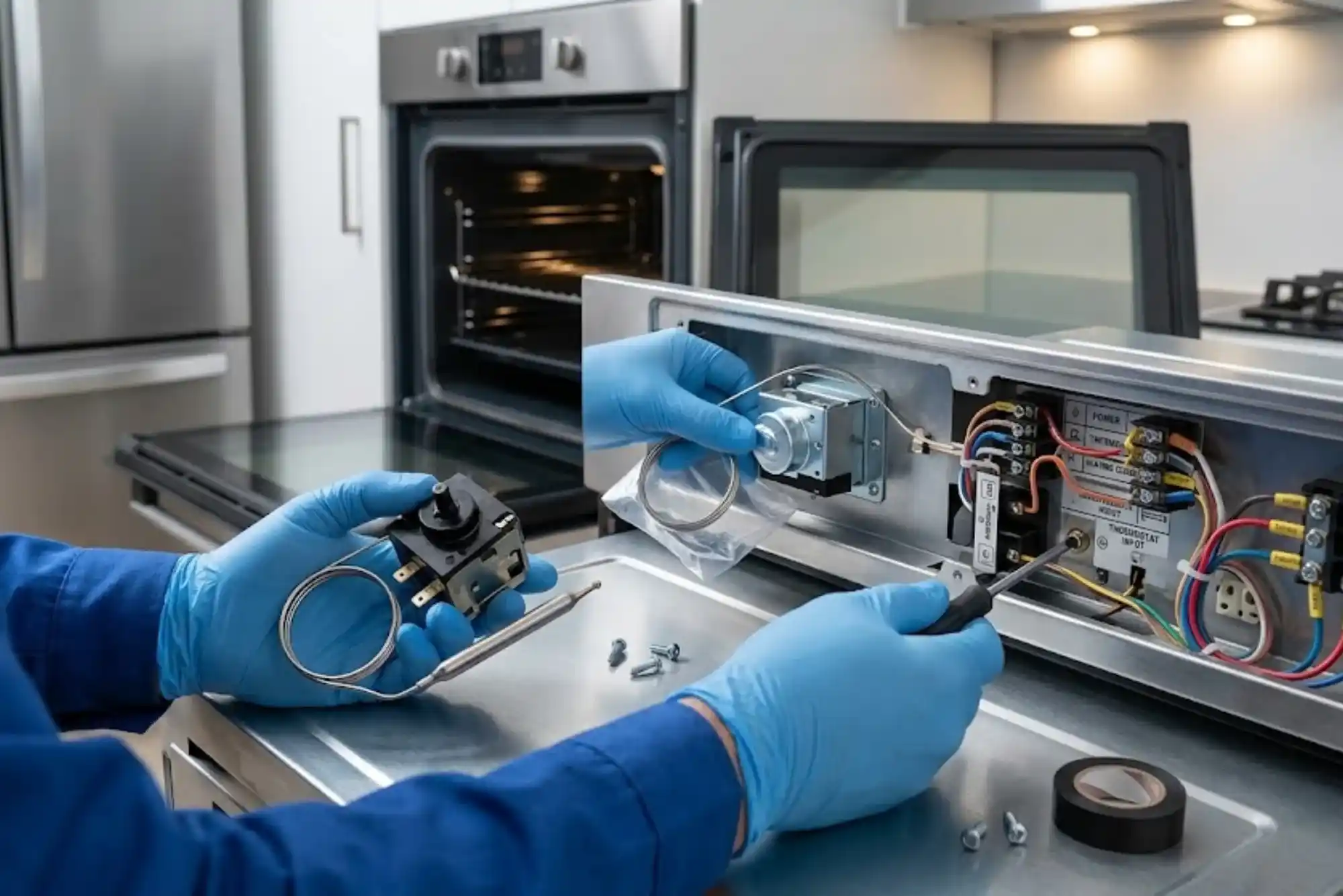
In an oven with a mechanical thermostat, a temperature-sensitive mechanism responds to heat and controls the heating circuit. Some designs use a sensing bulb connected to a capillary tube. As the temperature changes, the mechanism responds and switches heating operation accordingly.
Modern electric ovens may use an electronic temperature sensor connected to a control board. The sensor sends temperature information to the control system, which manages the heating elements according to the selected programme.

Although mechanical thermostats and electronic sensors perform related temperature-monitoring functions, they are not interchangeable components. The correct replacement depends on the oven’s manufacturer, model, design, and original part specification.
Signs Your Oven Thermostat May Need Replacement
An oven that does not maintain the selected temperature should be inspected before further use. The following symptoms can indicate a thermostat or temperature-control fault.
Oven Temperature Is Too High
If food burns even when the correct cooking temperature and time are selected, the thermostat may not be controlling heat accurately. However, an incorrect cooking setting, sensor fault, or control-board problem can produce similar results.
Oven Is Not Heating Properly
An oven that remains cooler than the selected setting may have a faulty thermostat, temperature sensor, heating element, or electrical connection. Professional testing is needed to identify the failed component.
Food Cooks Unevenly
Uneven cooking can occur when the oven temperature fluctuates or does not remain stable. It can also be caused by poor airflow, an incorrectly positioned rack, a damaged door seal, or a defective heating element.
Temperature Changes Unexpectedly
If the oven repeatedly becomes too hot or too cold during a cooking cycle, its temperature regulation system may not be responding correctly. A technician should inspect the thermostat, sensor, wiring, and control system.
Oven Takes Longer to Cook Food
Longer cooking times may indicate insufficient heating or inaccurate temperature readings. Replacing the thermostat will only solve the problem if testing confirms that it is responsible.
Common Causes of Oven Thermostat Problems
Oven temperature faults can develop for several reasons. Understanding the possible causes helps prevent unnecessary part replacement.
Component wear: Repeated heating and cooling cycles can affect mechanical and electronic components over time.
Temperature sensor failure: An electronic sensor may send inaccurate readings to the oven’s control board, resulting in incorrect heating decisions.
Damaged wiring: Loose, damaged, or overheated electrical connections can interrupt communication or power between temperature-control components.
Control board malfunction: An electronic control board may fail to interpret sensor readings or operate the heating circuit correctly.
Heating element damage: A defective heating element can prevent the oven from reaching the required temperature, even when the thermostat is functioning.
Door seal problems: Heat escaping through a damaged door gasket can affect cooking performance and make temperature maintenance difficult.
Correct diagnosis matters because these faults can produce similar symptoms but require different repairs.
Oven Thermostat Replacement for Electric and Gas Ovens
The replacement procedure depends on the oven’s fuel type and control design. Electric and gas ovens may use different temperature-control arrangements, so technicians must identify the appliance before selecting replacement components.
Electric Oven Thermostat Replacement
An electric oven uses electrical heating elements controlled through its temperature-regulation system. If the thermostat fails, the appliance may overheat, underheat, or struggle to maintain its selected temperature.
Electric Oven Thermostat Replacement may involve inspecting the thermostat, temperature sensor, wiring, heating elements, and control board. The technician should verify the failed component and install a compatible part designed for the exact oven model.
Gas Oven Thermostat Replacement
A gas oven uses a gas burner to generate heat. Its temperature-control system may involve a mechanical thermostat, electronic controls, ignition components, and safety devices.
Gas Oven Thermostat Replacement requires particular care because the appliance contains gas connections and combustion-related components. A qualified technician should inspect the temperature-control system and follow the manufacturer’s service instructions. Users should not attempt to adjust gas valves or dismantle gas components themselves.
Built-In Oven Thermostat Repair
Built-in ovens may be installed inside kitchen cabinets or fitted into dedicated appliance spaces. Access to internal components can require careful removal and reinstallation.
Built-In Oven Thermostat Repair should include checking the appliance’s installation, electrical isolation, component compatibility, and safe refitting. The oven should not be pulled out or dismantled by an unqualified person.
How Professional Oven Thermostat Replacement Is Carried Out
A reliable repair begins with diagnosis rather than immediately fitting a new thermostat. The technician needs to establish whether the fault is in the thermostat itself or another part of the temperature-control system.
Initial Inspection and Fault Diagnosis
The technician first checks the oven’s make, model, control type, and reported symptoms. The inspection may include checking whether the appliance powers on, whether its heating elements operate, and whether any error codes appear on the display.
The oven’s temperature sensor, thermostat, wiring connections, and control board may then be examined. This helps distinguish a thermostat fault from an electrical or heating-system problem.
Oven Thermostat Testing
Oven Thermostat Testing helps determine whether the temperature-control component is responding correctly. Depending on the oven design, a technician may use suitable electrical test equipment, inspect sensor resistance against manufacturer specifications, or follow the model’s diagnostic procedure.
A temperature-control fault should not be diagnosed from cooking results alone. For example, an oven that heats slowly may have a defective heating element rather than a faulty thermostat.
Selecting the Correct Replacement Part
The replacement component must match the oven’s make and model. Similar-looking thermostats or sensors may have different electrical ratings, connections, dimensions, or operating specifications.
Before installation, the technician should confirm the correct part number and compatibility using manufacturer documentation or reliable parts information. Using an unsuitable component can cause continued temperature problems or damage the appliance.
Removing and Installing the Component
The oven must be safely isolated from its power supply before electrical components are accessed. For gas appliances, the relevant gas-safety procedures must also be followed by a qualified person.
The technician removes the defective component, checks its connectors and surrounding wiring, and installs the compatible replacement according to the manufacturer’s instructions. This is the main stage of Oven Thermostat Installation.
Final Testing and Temperature Verification
After installation, the oven is reassembled and tested using the appropriate service procedure. The technician checks that the controls respond correctly, the heating system operates, and the oven can regulate temperature as intended.
Some models also provide a manufacturer-defined temperature calibration setting. Calibration is not the same as replacing a defective thermostat: it adjusts the temperature offset on supported models, while replacement addresses a failed physical component. Whirlpool and GE Appliances both explain that calibration procedures vary by model and that users should follow the relevant owner’s manual.
Thermostat Replacement or Oven Temperature Calibration?
Not every oven temperature problem requires a new thermostat. In some cases, the oven’s calibration setting may need adjustment; in others, a faulty sensor, heating element, or control board may be responsible.
| Problem identified | Possible action |
|---|---|
| Temperature is slightly different from the desired setting | Check the manufacturer’s calibration instructions |
| Thermostat fails diagnostic testing | Replace the compatible thermostat |
| Sensor readings are outside manufacturer specifications | Inspect or replace the temperature sensor |
| Oven does not produce sufficient heat | Check heating elements and electrical connections |
| Controls do not respond correctly | Inspect the control board and related wiring |
Whirlpool explains that some ovens allow temperature adjustment through the control panel, but the procedure differs between models. GE Appliances also provides model-dependent calibration instructions for gas and electric ovens.
Avoid changing calibration settings to compensate for a component that has not been tested. An incorrect adjustment may hide the original fault rather than resolve it.
Oven Thermostat Replacement in Dubai: Important Considerations
When arranging Oven Thermostat Replacement Dubai, provide the technician with accurate appliance information before the visit. This can help identify the correct replacement part and avoid delays caused by ordering an incompatible component.
Dubai homes may have different oven arrangements, including freestanding cookers, built-in electric ovens, and gas appliances. The appliance’s design and installation affect how a technician accesses its thermostat and related components.
Before arranging a repair, check the following details:
- Brand and model: Share the manufacturer’s name and model number, usually shown on the appliance identification label.
- Fuel type: Confirm whether the oven is electric or gas.
- Installation type: Explain whether it is freestanding, built-in, or part of a cooker.
- Symptoms: Describe whether the oven overheats, stays cold, fluctuates in temperature, or displays an error code.
- Previous repairs: Mention any recent thermostat, sensor, wiring, or heating-element work.
- Part compatibility: Ask whether the proposed replacement matches the exact model.
These details are useful for domestic appliances as well as commercial kitchen equipment. For a commercial oven, the technician should also understand the equipment’s operating requirements and the effect of downtime on kitchen work.
Benefits and Limitations of Replacing a Faulty Thermostat
A correctly diagnosed and completed thermostat replacement can restore proper temperature control when the thermostat is confirmed as the cause of the problem.
Potential benefits include more consistent temperature regulation, improved cooking performance, and reduced risk of food being exposed to excessive or insufficient heat. It may also help avoid unnecessary replacement of the entire oven when a compatible component repair is suitable.
However, thermostat replacement cannot correct every heating problem. If the actual fault is a damaged sensor, control board, heating element, wiring connection, or door seal, replacing the thermostat alone may not resolve the symptoms.
The repair decision should therefore be based on the appliance’s condition, the availability of compatible parts, the diagnosis, and the estimated repair cost. A technician should explain whether Oven Thermostat Repair or a complete Oven Temperature Control Replacement is appropriate.
Common Mistakes to Avoid
Replacing Parts Without Diagnosis
A faulty thermostat is only one possible cause of inaccurate oven temperature. Replacing it without checking related components can lead to unnecessary expense and leave the original problem unresolved.
Choosing a Part Only by Appearance
A thermostat that looks similar to the original may not be electrically or mechanically compatible. Always verify the model and part specification.
Confusing a Sensor With a Thermostat
An oven temperature sensor and a thermostat are related but distinct components. Some ovens use electronic sensors and control boards instead of a conventional mechanical thermostat. Oven Temperature Sensor Replacement should only be recommended when testing identifies the sensor as defective.
Attempting Electrical or Gas Repairs Without Training
Opening an oven can expose dangerous electrical connections and hot components. Gas ovens also involve gas and ignition systems. Users should not dismantle internal components, bypass safety devices, or attempt gas adjustments.
Ignoring Other Heating-System Faults
A thermostat may be functioning correctly while a heating element or electrical connection has failed. If the oven remains cold after a thermostat repair, further Oven Heating Problem Repair may be necessary.
When to Contact a Professional Oven Repair Service
Contact a qualified appliance technician if the oven repeatedly overheats, fails to reach the selected temperature, displays temperature-related error codes, or behaves unpredictably during cooking.
Stop using the appliance and arrange an inspection if you notice burning smells, visible electrical damage, sparks, or unusual heating. If you suspect a gas leak, avoid operating electrical switches or flames, leave the area, and contact the appropriate emergency or gas service.
A Professional Oven Repair Service should explain the diagnosis, identify the component requiring attention, and confirm the replacement part before proceeding. Ask whether the service includes post-repair testing and whether any warranty applies to the replacement part or workmanship. Warranty terms should be confirmed directly rather than assumed.
For related heating faults, readers can also explore Oven Heating System Repair, which covers the wider system responsible for generating and controlling oven heat.
Domestic and Commercial Oven Thermostat Repair
Domestic Oven Thermostat Replacement is focused on restoring the temperature control of household appliances. The technician should consider the oven’s age, condition, model compatibility, and the availability of suitable replacement parts.
Commercial Oven Thermostat Repair may involve equipment used for frequent or extended cooking operations. Commercial appliances can have different control arrangements and service requirements, so the equipment model and manufacturer’s instructions remain essential.
In both situations, a successful repair depends on identifying the actual fault, using a compatible component, and completing the required safety and performance checks. Replacing a thermostat without confirming the cause of the temperature problem is not a reliable repair strategy.
How to Choose the Right Repair Solution
Before approving an Oven Thermostat Replacement, ask the repair provider to explain the fault and the proposed work. A clear diagnosis should identify whether the issue involves the thermostat, sensor, heating element, wiring, or electronic controls.
Request confirmation of the replacement part’s compatibility with your oven model. Ask for a breakdown of the inspection, parts, labour, and any additional work so you can compare the repair cost with the value and condition of the appliance.
There is no single replacement price that can be applied to every oven. The cost depends on the appliance design, the component required, part availability, access to the component, and the work involved. If the provider does not publish a fixed price, treat the service as quote-based and request a direct estimate before authorising the repair.
A suitable repair is one that addresses the confirmed fault, uses the correct component, and leaves the appliance operating safely according to its manufacturer’s requirements.
5. FREQUENTLY ASKED QUESTIONS (FAQ)
1. How do I know if my oven thermostat needs replacement?
Signs include overheating, inconsistent temperatures, food cooking unevenly, or the oven failing to reach its selected temperature. These symptoms can also indicate sensor, heating-element, or control-board faults, so testing is necessary before replacement.
2. Can an oven thermostat be repaired instead of replaced?
It depends on the component design and the fault. Some temperature-control problems may be resolved through calibration or a repair to a related connection, while a defective thermostat may require replacement with a compatible part.
3. How long does oven thermostat replacement take?
The time depends on the oven model, component location, installation type, and availability of the correct replacement part. The repair provider can give a more accurate estimate after inspecting the appliance.
4. Is oven thermostat replacement different for gas and electric ovens?
Yes. Gas and electric ovens use different heating systems and may have different temperature-control arrangements. Gas oven repairs also require appropriate precautions when working around gas and ignition components.
5. Does an oven always need a new thermostat if the temperature is incorrect?
No. The problem may be caused by an electronic temperature sensor, heating element, wiring, control board, or calibration setting. A technician should diagnose the appliance before recommending a replacement.
6. How much does oven thermostat replacement cost in Dubai?
There is no single verified price for every oven. The cost depends on the model, replacement component, part availability, and labour involved. Contact the repair provider for a quote after diagnosis.
Related Reading: Dryer Thermostat Bypass