An oven that cooks one side of a tray and leaves the other raw is not a mystery — it is a fault with a name, and usually a fixable one. If you have recently moved to the Emirates, UAE Travel Brief is a useful first read on daily life here; this guide stays on the oven: the faults Sharjah technicians see most, the checks that are safe at home, and how to tell a small repair from a unit that is not worth saving.
The faults that bring ovens in
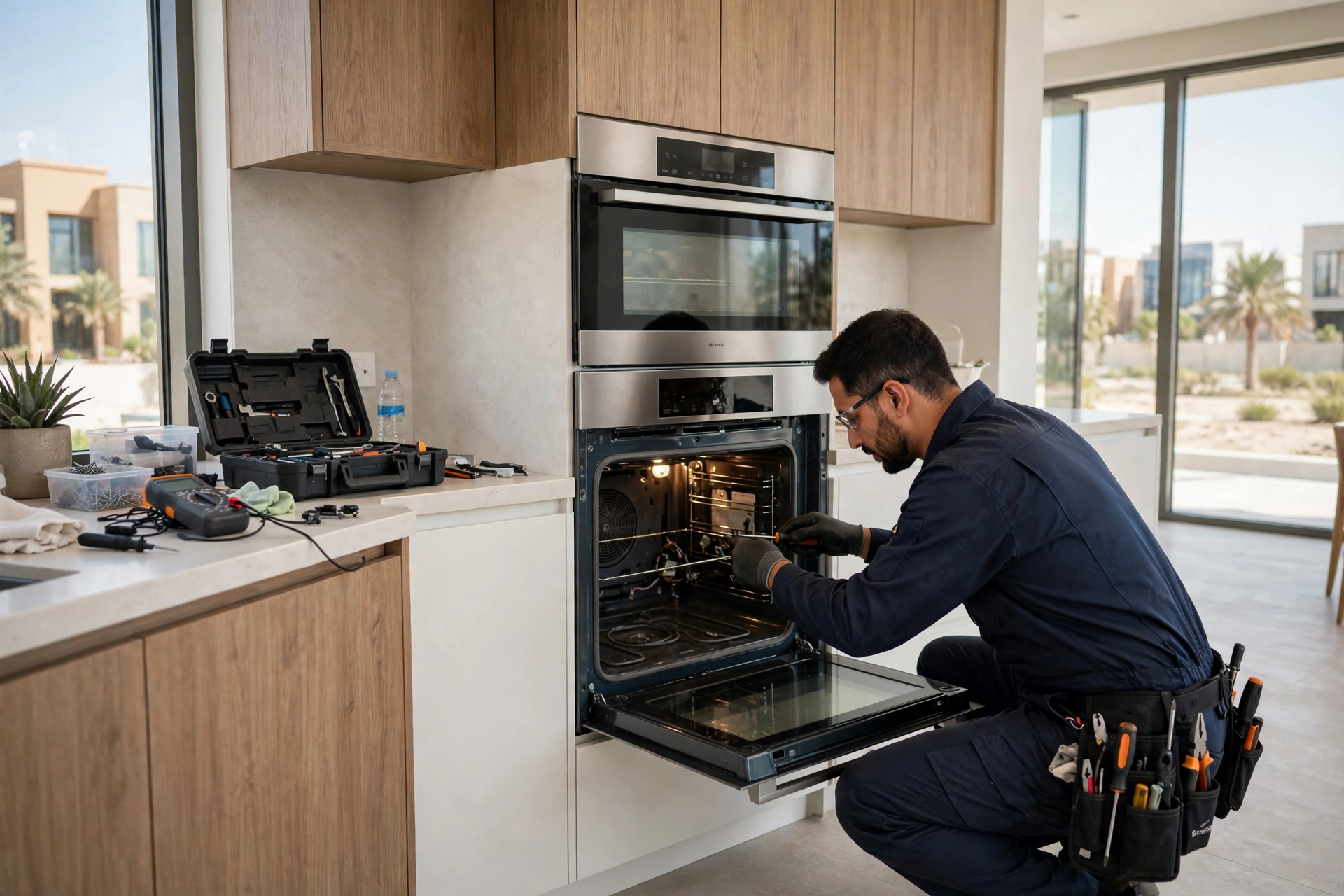
Most oven call-outs fall into a handful of patterns. The most common is an oven that heats unevenly or not at all. On an electric oven that usually means a failed heating element — top, bottom or fan element — or a thermostat that no longer reads the temperature correctly. On a gas oven it is more often the igniter: the oven clicks, or stays silent, and the gas never lights.
Second is an oven that overheats — food burns on the outside while the dial says 180°C. That is almost always a faulty thermostat or a temperature sensor that has drifted. It is a real problem, not an annoyance: an oven that runs hotter than its dial says is also a safety risk, and it should be checked rather than worked around.
Third is a door that does not close properly. A worn door seal lets heat escape, so the oven takes longer, cooks unevenly and costs more to run. A broken hinge is worse — a door that drops or will not stay shut needs a hinge, not a workaround. Both are routine repairs, and a new seal is one of the cheapest ways to make an old oven behave like a new one.
Fourth is a control panel that is dead, unresponsive or showing an error code. Sometimes that is a failed control board; sometimes it is as simple as a loose connection or a keypad worn out by steam and heat. The difference matters, because a board is a major repair and a connection is not — and an honest diagnosis tells you which one it is before any part is ordered.
Fifth is a fan oven whose fan has stopped. The oven still heats, but the heat sits in one place. Food comes out burnt on top and raw underneath. A failed fan motor is a straightforward replacement, and the fix restores the even cooking the oven was built for.
What you can safely check yourself
A few checks are safe, and they are worth doing before you call anyone.
First, test with an oven thermometer if you have one — or a simple tray of sliced bread. If the dial says 180°C and the thermometer says 220°C, the thermostat has drifted and you have your answer. If the oven never reaches temperature at all, note how long you waited; a healthy oven reaches 180°C in ten to fifteen minutes.
Second, look at the elements on an electric oven. With the oven cool and off, open the door and look at the top and bottom elements. A healthy element is evenly coloured; a failed one often has a visible blister, a crack or a bright spot. Do not touch a hot element, and do not try to test it with power on.
Third, check the door seal properly. Run a finger along it and look for gaps, flat spots or tears. Close the door on a sheet of paper — if it pulls out easily in one corner, the seal is not gripping there. A failed seal is the most underrated cause of uneven cooking.
Fourth, check the power and the gas supply. An electric oven that is completely dead may have tripped its breaker; a gas oven that will not light may have a closed valve or an empty supply. Check the obvious before assuming the worst.
Fifth, write down the error code. If the display shows a code, photograph it. It tells the technician exactly where to start, and it can turn a two-visit job into one.
Do not open the back panel, and do not attempt to replace a gas igniter or a heating element yourself. Gas work and mains wiring are not do-it-yourself jobs under any circumstances.
Gas ovens need a different kind of care
Gas ovens deserve a note of their own. If you ever smell gas near the oven, do not switch it on, do not touch any electrical switch, ventilate the room and call a technician immediately. If the oven lights but the flame is yellow and lazy instead of blue and steady, the burner needs cleaning or adjustment — a yellow flame is inefficient and can produce carbon monoxide. And if the oven clicks repeatedly without lighting, stop trying; repeated ignition attempts fill the cavity with unburnt gas.
How much should an oven repair cost?
It follows the part. A door seal, a fan motor, an igniter or a single heating element are all modest repairs. A control board or a full thermostat assembly costs more, and on a very old oven the honest advice may be that a replacement makes more sense. That is the conversation a proper diagnosis is for: the fault is found, the price is explained in plain terms, and you decide with real numbers in front of you.
Our other guides follow the same approach. If the rest of the kitchen is giving trouble, our Cooker Hood Repair Dubai guide covers weak suction and noisy fans, and our Fridge Repair Sharjah guide covers the fridge faults that most often appear in the same homes.
How to make an oven last longer
A few habits add years. Clean spills promptly — burnt-on food on the elements and the cavity floor is what kills heating elements and damages seals. Do not slam the door; the hinges and the seal take the impact every time. Leave the door ajar for a few minutes after cooking so steam escapes instead of condensing on the control panel. Have the seal checked once a year, and the thermostat checked if cooking times start drifting. And if the oven is gas, have the burners and the igniter serviced annually — a clean burner lights first time, every time.
In a Sharjah home where the oven runs most days, those small habits are the difference between an oven that lasts five years and one that lasts twelve.
FAQ
My oven heats unevenly. Is it finished?
Usually not. A failed element, a worn door seal or a dead fan motor are all common, repairable faults. A thermostat that has drifted is also fixable.
The oven is completely dead. Should I replace it?
Not necessarily. A tripped breaker, a failed control board or a loose connection are all possibilities. Ask for a diagnosis first — if it is the board on an old unit, the technician should say honestly that replacement is better value.
My gas oven will not light. What should I do?
Check the gas supply, then stop trying if it keeps clicking without lighting. Repeated attempts fill the oven with unburnt gas. Call a technician — gas ignition is not a do-it-yourself job.
The oven door will not stay shut. Can that be fixed?
Yes — a worn hinge or a failed door seal is a routine repair, and a new seal is one of the cheapest ways to restore even cooking.
How quickly can an oven be repaired in Sharjah?
Most common faults are fixed in a single visit once diagnosed. Muhammad Hasnain Repair works 09:00–17:00 daily — call +971 52 245 1145 or 04 288 7292 to book a visit.
Related Reading: AC Repair Ajman — Fast Cooling Fix, Same Week — full guide